©85
The House That Swallowed Suburbia
Design
Design
Story
The Invisible Craft
Design is the first thing our customers see, not the functionality, features, or capabilities of the product. Why is this something I think about, I once knew a man who painted his house like a fever dream.
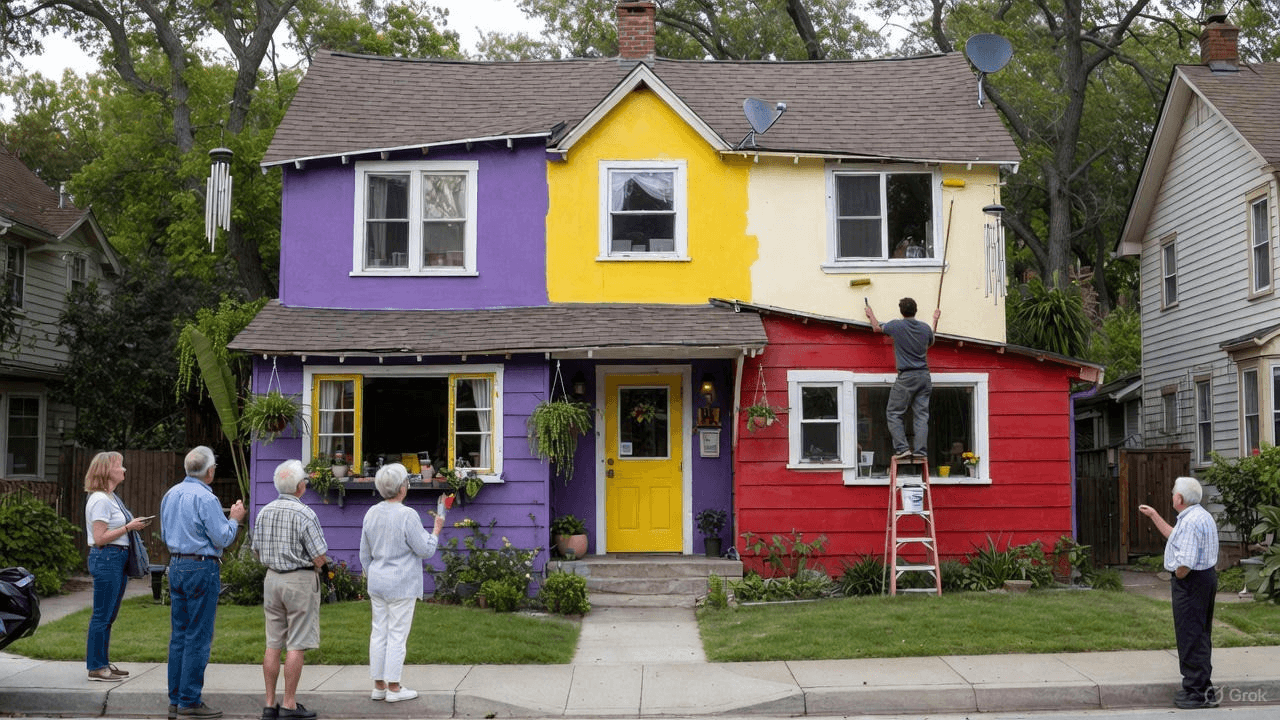
Not the polite kind of fever dream, the kind that gets you a gentle pat on the back and a “how creative” from the HOA. No, this was the full-blown, Technicolor, what-the-hell-is-wrong-with-you variety. Purple bled into yellow. Red dripped like a crime scene. The garage door looked like a Mondrian on mescaline. He stood in the yard shirtless, belly proud, holding a paint roller like a scepter. The neighbors circled with clipboards and quiet panic. The man just smiled, barefoot in the grass, and kept painting.
I think about that house every time someone tells me, “Design? Eh, we’ll figure it out later.”
Because here’s the thing: that house didn’t need to be subtle. It didn’t need to whisper. It screamed. And in that scream was a truth most brands spend years and millions trying to bury:
Your customer sees the paint job before they ever knock on the door.
The Invisible Craft
You don’t notice good design the way you notice a root canal. You just… feel better. The app loads without friction. The menu doesn’t make you squint. The email subject line lands like a joke you didn’t know you needed. It’s anesthesia for the soul.
But flip it. Bad design? That’s the root canal. The website that takes four clicks to find the price. The logo that looks like it was birthed in a 1998 PowerPoint. The packaging that fights you like a raccoon in a trash bag.
We call this “table stakes” in boardrooms. We call it “nice to have” in budgets. We call it anything but what it is: the first handshake. The first impression. The first reason someone stays or walks.
The Man Who Painted His Truth
Let’s go back to our barefoot Picasso.
He wasn’t a designer by trade. He was a retired mechanic who’d spent forty years under hoods, wrists deep in grease, listening to engines cough their last. When he finally bought the little brick ranch in a cul-de-sac of beige conformity, he didn’t see walls. He saw canvas.
He didn’t ask permission. He didn’t A/B test the palette. He just did.
And here’s what happened:
Kids slowed their bikes.
Joggers took selfies.
The mailman lingered.
One neighbor, after three weeks of side-eye knocked and asked if he could paint his shed.
The house became a landmark. Not because it was beautiful in the Instagram way. But because it was undeniable. You couldn’t unsee it. You couldn’t ignore it. It forced a reaction.
That’s what design does when it’s allowed to breathe.
The Quiet Revolution in Your Pocket
Open your phone. Scroll to the app you use without thinking. The one that just works. The icon that sits in your dock like it belongs there.
Now imagine it ugly. Clunky. A color that hurts. A name in Comic Sans.
You wouldn’t download it. You wouldn’t trust it. You’d swipe past like it owed you money.
That app? Someone fought for the curve of that button. Someone argued over the weight of that font. Someone lost sleep making sure the loading spinner didn’t make you feel stupid.
You’ll never know their name. But you’ll open the app tomorrow. And the day after.
That’s power.
To the Non-Designer Reading This
You’re the CFO. The founder. The PM who “just needs it to work.” You’re not wrong to care about function. You’re wrong to think form is optional.
Think of design like seasoning. You can eat a steak without salt. You can. But why would you?
Your product might solve the problem. Great. But if the wrapper makes people flinch, they’ll never taste the steak.
Hire the person who obsesses over the salt. Give them a seat early. Let them paint the house.
To the Designer Reading This
You already know the house is the first story.
Your job isn’t to make things pretty. It’s to make them mean something before anyone reads the copy or clicks the button. It’s to build the door people want to walk through.
You’re not the decorator. You’re the architect of first impressions.
When they say “it’s just design,” remember the man with the roller. Remember the neighbors who couldn’t look away.
You don’t need permission to paint. Just courage.
The Aftermath
Years later, I drove past that house. The colors had faded, but the shape remained. Someone new lived there. They’d kept the paint. Added a porch swing. Planted tomatoes in the front yard like nothing had ever happened.
The revolution was quiet. But it stuck.
Your work can too.
Not because it’s loud. But because it’s true.
And truth, like a purple garage door in a sea of beige, is impossible to un-see.
The Man Who Painted His Truth
Let’s go back to our barefoot Picasso.
Contact Now
Contact Me!
Let’s create something amazing together! Reach out I’d love to hear about your project and ideas.
Get your discovery call scheduled
Limited openings available