
©85
40 Years*
Whether it’s through stunning designs seamless user experiences, I’m dedicated to delivering work that resonates.
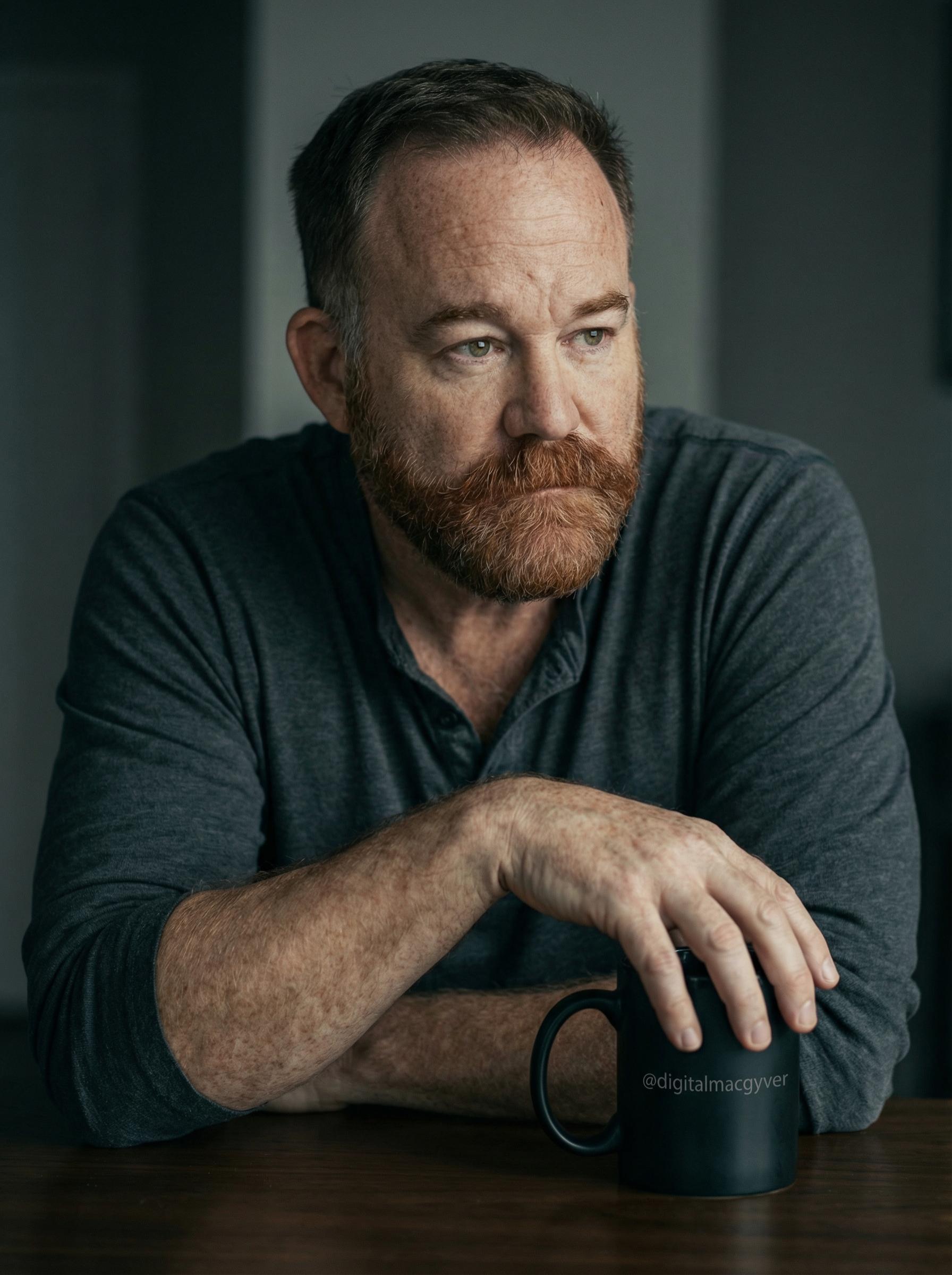
The Journey
DIGITAL MACGYVER
©85
Celebrating 40 Years of Digital MacGyver: A Journey of Innovation, Resilience, and Impact
As we step into 2025, I find myself reflecting on a milestone that feels both surreal and profoundly gratifying: the 40th anniversary of Digital MacGyver. What began in 1985 as a playful moniker for my resourceful approach to solving complex problems with whatever tools were at hand has evolved into a lifelong philosophy and career-defining identity. Inspired by the iconic TV character who could MacGyver his way out of any jam using everyday items, Digital MacGyver represents my commitment to ingenuity in the digital realm—whether it's troubleshooting tech glitches, optimizing business processes, or bridging gaps in organizational efficiency. Over four decades, this mindset has taken me from the snowy slopes of Montana to boardrooms across North America, collaborating with Fortune 500 companies, startups, nonprofits, and government entities.
This article is a celebration of that journey. It's not just a chronological recounting of roles and projects; it's a testament to the power of adaptability, continuous learning, and the human element in technology. Drawing from my timeline of experiences—spanning game design, computer forensics, consulting, and beyond—I'll share stories of challenges overcome, successes achieved, and lessons that continue to shape my work. If you're a professional navigating the ever-shifting landscape of digital transformation, I hope this inspires you to embrace your inner MacGyver. Let's dive in.
The Genesis: 1985–1990, Laying the Foundations in Montana
My story as Digital MacGyver officially kicked off in 1985, amid the breathtaking vistas of Glacier National Park in Montana. Eager for adventure, I took on seasonal work there, but it was during those long summer days that I first tinkered with early digital tools. Personal computers were just becoming accessible, and I found myself fixing rudimentary systems for park operations—rigging up basic databases from floppy disks and troubleshooting hardware with nothing but a screwdriver and sheer determination. This was the birth of Digital MacGyver: solving real-world problems in resource-scarce environments.
By 1986, I transitioned to Stockman's Brewery, where I managed inventory systems using early spreadsheet software. It was rudimentary by today's standards, but it taught me the value of automation. I'd jury-rig scripts to track stock levels, preventing shortages during peak seasons. This hands-on experience honed my problem-solving skills, emphasizing that technology isn't about fancy gadgets—it's about making what you have work better.
In 1987, I dove deeper into the emerging world of gaming and entertainment technology. Working at Moose's Saloon in Montana, I handled point-of-sale systems, but my real passion ignited with roles at Namco and Atari from 1987 to 1991. These were the golden years of arcade gaming, and I contributed to system maintenance and early digital interfaces. At Namco, I troubleshot hardware for classics like Pac-Man machines, often improvising fixes on the fly during busy nights. Atari exposed me to home console innovations, where I learned about user experience design long before it was a buzzword.
Parallel to this, from 1988, I worked at Big Mountain Ski Resort, integrating tech into operations, like early reservation systems. Balancing these roles built my resilience; Montana's harsh winters mirrored the unpredictable nature of tech projects. By 1989, while attending Missoula Schools at Hellgate High School, I volunteered at MCAT doing video production and broadcast management. In 1990, blending science with emerging digital tools for study aids.
The capstone of this era was my enlistment in the USAF in 1991. Over four years, I traveled to 37 countries, applying Digital MacGyver principles to military tech. From deploying communication systems in remote bases to fixing avionics with limited resources, this period solidified my global perspective. It wasn't just about tech; it was about cultural adaptability and high-stakes problem-solving. These foundational years set the stage for a career that would span industries and continents.
The 1990s: From Gaming to Global Adventures
The mid-1990s marked a pivotal shift as I moved to Portland, Oregon, in 1997. This relocation opened doors to the burgeoning tech scene on the West Coast. Earlier, from 1994 to 1996, I was a founding member of Lonestar Unlimited, a group focused on innovative tech solutions for entertainment. We experimented with early multimedia, blending hardware and software in ways that foreshadowed modern VR.
In 1995, at Aladdin Castle (an arcade chain) I refined my gaming expertise, optimizing networks for multiplayer setups. But 1997 brought my role as a Game Designer and Military Advisor at Sierra Entertainment Systems. Drawing from my USAF experience, I consulted on realistic simulations for military-themed games. This was where Digital MacGyver truly shone: I'd hack together prototypes using off-the-shelf components, turning concepts into playable demos overnight.
These experiences emphasized creativity under constraints. In gaming, deadlines were tight, budgets slim, and tech evolving rapidly. I learned to iterate quickly, a skill that would prove invaluable in consulting. By the end of the decade, I'd laid a versatile foundation, blending entertainment tech with practical applications.
Entering the 2000s: Forensics, Consulting, and Corporate Collaborations
The turn of the millennium thrust me into more structured tech roles. In 2004, I joined the U.S. Department of Energy as a Computer Forensic Technician. This was a leap into cybersecurity and data recovery, where I analyzed digital evidence for investigations. MacGyvering tools from open-source software, I'd recover lost data from corrupted drives, often in time-sensitive scenarios. That same year, at Discover-e Legal, I specialized in e-discovery, helping legal teams navigate digital evidence in litigation.
2005 took me to Legal Tech NY, where I networked and absorbed trends in legal technology. By 2006, a big trip to London for Computer Forensics Training expanded my expertise, learning advanced techniques in data forensics amid international standards.
From 2007 to 2012, I founded and ran Vernian Design Company, a boutique firm offering custom tech solutions. This entrepreneurial venture allowed me to apply Digital MacGyver across clients, from web design to system integrations.
2008 was a banner year: Collaborations with Nike, Port of Seattle, Aivea, and Washington Companies (under retainer since then). At Nike, I optimized supply chain databases; at Port of Seattle, I enhanced port management systems with improvised analytics tools. Microsoft engagements from 2008–2011 and 2012–2016 involved cloud migrations and enterprise solutions, where I troubleshot large-scale implementations.
Other highlights included Disney in 2009, where I streamlined digital asset management, and Slalom Consulting (2009–2012), contributing to agile projects. Port of Portland (2009–2011) and Weyerhaeuser (2009) saw me improving logistics tech. City of Garland in 2009 benefited from my municipal IT optimizations.
In 2010, roles at Home Depot, Standard Insurance, and taking presidency of the Portland SharePoint User Group, expanded my community impact. As president, I grew the group, fostering knowledge-sharing on SharePoint, which tied into my Microsoft work.
2011 brought Columbia Distributing, Columbia Sportswear, and speaking at the Microsoft Innovations Conference on retention, records management, and litigation readiness. Sharing stages with industry leaders, I highlighted practical MacGyver strategies for compliance.
This decade taught me the intersection of tech and business. Successes like streamlining operations at major ports saved millions in efficiency gains, while failures (like a botched migration) reinforced the need for thorough testing.
The 2010s: Expansion, Partnerships, and Relocation
Building momentum, 2012–2013 included Blount - Oregon Chain and Portland Trailblazers. For the Trailblazers, I enhanced fan engagement platforms; at Blount, supply chain tech. Microsoft continued, alongside Lattice Semiconductor (2013) and Aequitas Capital Management (2013–2016).
Warn Industries (2013–2014) and Delta 1 Advisors (2014) focused on manufacturing and financial tech. SharePoint Innovations in 2014 deepened my expertise in collaboration tools.
A major life change came in 2016: Moving to Montana, reconnecting with roots while maintaining remote work. Welocalize (2015–2022) involved localization tech for global content.
2017–2018 at Jenner and Block in Chicago honed legal tech skills. Partnership with PEI - Colorado (2018–2019) expanded consulting networks.
The 2010s solidified my consulting prowess, with long-term retainers proving the value of sustained relationships. Digital MacGyver evolved from solo fixes to scalable strategies.
The 2020s: Adaptation Amid Challenges and New Horizons
The 2020s began tumultuously. 2020–2022 at Shane Co. involved e-commerce optimizations during pandemic shifts.
City of Bend, Oregon (2020) and Colorado School of Mines (2021) saw educational tech implementations.
2021 was marked by "Well, that happened"—a nod to global upheavals—but also Goodwill Industries of Georgia and continued growth.
2022 brought Travel Oregon and Red Clay Consulting, focusing on tourism tech and utilities.
2023 exploded with activity: University of Oregon, Cutsforth, founding Making Oregon (a nonprofit?), Synovus Bank, Downward Dog Training, Washington Companies retainer, Travel Oregon again, partnership with BlueROCK, Seaspan, and SymphonyAI (2023–2024).
Founding Making Oregon in 2023 was a passion project, likely promoting local innovation. These roles emphasized AI and data-driven decisions.
2024–2025 included Bezos Academy (education tech), Motion Recruitment, GE Vernova, BlueRock Consulting, British Columbia Institute of Technology, and NetWoven.
Into 2025: City of Gresham, Principal Financial Group, Metropolitan Business Association, S2 Imaging, PDX Woodworks/Portland Table Company, NRI North America (with Kroger and Cleveland Clinics).
These recent years, highlight resilience. Amid economic shifts, I've adapted to AI, remote work, and sustainability tech. Successes like optimizing healthcare data at Cleveland Clinics or retail systems at Kroger underscore impact.
Reflections: Lessons from 40 Years
Over 40 years, Digital MacGyver has taught me:
Adaptability is Key: From arcades to AI, tech changes; resourcefulness endures.
Relationships Matter: Long-term retainers like Washington Companies prove trust builds empires.
Community Gives Back: Leading user groups and founding initiatives amplifies impact.
Innovation Under Constraints: True MacGyvering shines when resources are limited.
Global Perspective: 37 countries informed inclusive tech solutions.
Challenges? Plenty….tech failures, relocations, pandemics. But each built character.
Looking Ahead: The Next Chapter
As we celebrate this anniversary, I'm excited for 2026 and beyond. New friends and collegues, and the journey of Digital MacGyver continues to evolve, perhaps into AI ethics, new fields of engineering, growing my maker side in Oregon, who knows..
If my journey resonates, connect on LinkedIn. Let's collaborate; ready to add yours to the list?
In closing, thank you for joining this reflection. Here's to 40 more years of ingenuity.
Featured Stack
DIGITAL MACGYVER
©85
Daily Stack
Favorite Tools
My favorite stack includes Framer, Figma, and other cutting-edge technologies to ensure seamless and dynamic designs.

Framer - Development
Combining design, prototyping, and development in one platform, it empowers creators to build visually stunning, high-performance websites.

Figma - Web Designing
Figma is a powerful, collaborative design tool that enables real-time collaboration and seamless workflow. With its top intuitive interface and versatile features.

Notion - Productivity
Notion is an all-in-one workspace that combines note-taking, task management, databases, and collaboration features. With its flexible and customizable interface.

Android - Phone
One of most versitle tools I have with me at all times. A digital swiss-army knife

Nikon - Photography
Renowned for precision, innovation, and reliability, Nikon empowers photographers and videographers to capture stunning visuals with exceptional clarity and detail.
FAQ
01
What exactly does Digital MacGyver do?
02
Who hires you?
03
How do your consulting engagements work?
04
What’s your process like?
05
Do you offer coaching or mentorship?
06
What’s the difference between consulting and coaching with you?
07
How easy is it to edit for beginners?
08
Do I need to know how to code?
Let's Work Together
DIGITAL MACGYVER
©85
Contact Now
Contact Me!
Let’s create something amazing together! Reach out I’d love to hear about your project and ideas.
Get your discovery call scheduled
Limited openings available
©85
40 Years*
Whether it’s through stunning designs or seamless user experiences, I’m dedicated to delivering work that inspires and resonates.
The Journey
©85
Celebrating 40 Years of Digital MacGyver: A Journey of Innovation, Resilience, and Impact
As we step into 2025, I find myself reflecting on a milestone that feels both surreal and profoundly gratifying: the 40th anniversary of Digital MacGyver. What began in 1985 as a playful moniker for my resourceful approach to solving complex problems with whatever tools were at hand has evolved into a lifelong philosophy and career-defining identity. Inspired by the iconic TV character who could MacGyver his way out of any jam using everyday items, Digital MacGyver represents my commitment to ingenuity in the digital realm—whether it's troubleshooting tech glitches, optimizing business processes, or bridging gaps in organizational efficiency. Over four decades, this mindset has taken me from the snowy slopes of Montana to boardrooms across North America, collaborating with Fortune 500 companies, startups, nonprofits, and government entities.
This article is a celebration of that journey. It's not just a chronological recounting of roles and projects; it's a testament to the power of adaptability, continuous learning, and the human element in technology. Drawing from my timeline of experiences—spanning game design, computer forensics, consulting, and beyond—I'll share stories of challenges overcome, successes achieved, and lessons that continue to shape my work. If you're a professional navigating the ever-shifting landscape of digital transformation, I hope this inspires you to embrace your inner MacGyver. Let's dive in.
The Genesis: 1985–1990, Laying the Foundations in Montana
My story as Digital MacGyver officially kicked off in 1985, amid the breathtaking vistas of Glacier National Park in Montana. Eager for adventure, I took on seasonal work there, but it was during those long summer days that I first tinkered with early digital tools. Personal computers were just becoming accessible, and I found myself fixing rudimentary systems for park operations—rigging up basic databases from floppy disks and troubleshooting hardware with nothing but a screwdriver and sheer determination. This was the birth of Digital MacGyver: solving real-world problems in resource-scarce environments.
By 1986, I transitioned to Stockman's Brewery, where I managed inventory systems using early spreadsheet software. It was rudimentary by today's standards, but it taught me the value of automation. I'd jury-rig scripts to track stock levels, preventing shortages during peak seasons. This hands-on experience honed my problem-solving skills, emphasizing that technology isn't about fancy gadgets—it's about making what you have work better.
In 1987, I dove deeper into the emerging world of gaming and entertainment technology. Working at Moose's Saloon in Montana, I handled point-of-sale systems, but my real passion ignited with roles at Namco and Atari from 1987 to 1991. These were the golden years of arcade gaming, and I contributed to system maintenance and early digital interfaces. At Namco, I troubleshot hardware for classics like Pac-Man machines, often improvising fixes on the fly during busy nights. Atari exposed me to home console innovations, where I learned about user experience design long before it was a buzzword.
Parallel to this, from 1988, I worked at Big Mountain Ski Resort, integrating tech into operations, like early reservation systems. Balancing these roles built my resilience; Montana's harsh winters mirrored the unpredictable nature of tech projects. By 1989, while attending Missoula Schools at Hellgate High School, I volunteered at MCAT doing video production and broadcast management. In 1990, blending science with emerging digital tools for study aids.
The capstone of this era was my enlistment in the USAF in 1991. Over four years, I traveled to 37 countries, applying Digital MacGyver principles to military tech. From deploying communication systems in remote bases to fixing avionics with limited resources, this period solidified my global perspective. It wasn't just about tech; it was about cultural adaptability and high-stakes problem-solving. These foundational years set the stage for a career that would span industries and continents.
The 1990s: From Gaming to Global Adventures
The mid-1990s marked a pivotal shift as I moved to Portland, Oregon, in 1997. This relocation opened doors to the burgeoning tech scene on the West Coast. Earlier, from 1994 to 1996, I was a founding member of Lonestar Unlimited, a group focused on innovative tech solutions for entertainment. We experimented with early multimedia, blending hardware and software in ways that foreshadowed modern VR.
In 1995, at Aladdin Castle (an arcade chain) I refined my gaming expertise, optimizing networks for multiplayer setups. But 1997 brought my role as a Game Designer and Military Advisor at Sierra Entertainment Systems. Drawing from my USAF experience, I consulted on realistic simulations for military-themed games. This was where Digital MacGyver truly shone: I'd hack together prototypes using off-the-shelf components, turning concepts into playable demos overnight.
These experiences emphasized creativity under constraints. In gaming, deadlines were tight, budgets slim, and tech evolving rapidly. I learned to iterate quickly, a skill that would prove invaluable in consulting. By the end of the decade, I'd laid a versatile foundation, blending entertainment tech with practical applications.
Entering the 2000s: Forensics, Consulting, and Corporate Collaborations
The turn of the millennium thrust me into more structured tech roles. In 2004, I joined the U.S. Department of Energy as a Computer Forensic Technician. This was a leap into cybersecurity and data recovery, where I analyzed digital evidence for investigations. MacGyvering tools from open-source software, I'd recover lost data from corrupted drives, often in time-sensitive scenarios. That same year, at Discover-e Legal, I specialized in e-discovery, helping legal teams navigate digital evidence in litigation.
2005 took me to Legal Tech NY, where I networked and absorbed trends in legal technology. By 2006, a big trip to London for Computer Forensics Training expanded my expertise, learning advanced techniques in data forensics amid international standards.
From 2007 to 2012, I founded and ran Vernian Design Company, a boutique firm offering custom tech solutions. This entrepreneurial venture allowed me to apply Digital MacGyver across clients, from web design to system integrations.
2008 was a banner year: Collaborations with Nike, Port of Seattle, Aivea, and Washington Companies (under retainer since then). At Nike, I optimized supply chain databases; at Port of Seattle, I enhanced port management systems with improvised analytics tools. Microsoft engagements from 2008–2011 and 2012–2016 involved cloud migrations and enterprise solutions, where I troubleshot large-scale implementations.
Other highlights included Disney in 2009, where I streamlined digital asset management, and Slalom Consulting (2009–2012), contributing to agile projects. Port of Portland (2009–2011) and Weyerhaeuser (2009) saw me improving logistics tech. City of Garland in 2009 benefited from my municipal IT optimizations.
In 2010, roles at Home Depot, Standard Insurance, and taking presidency of the Portland SharePoint User Group, expanded my community impact. As president, I grew the group, fostering knowledge-sharing on SharePoint, which tied into my Microsoft work.
2011 brought Columbia Distributing, Columbia Sportswear, and speaking at the Microsoft Innovations Conference on retention, records management, and litigation readiness. Sharing stages with industry leaders, I highlighted practical MacGyver strategies for compliance.
This decade taught me the intersection of tech and business. Successes like streamlining operations at major ports saved millions in efficiency gains, while failures (like a botched migration) reinforced the need for thorough testing.
The 2010s: Expansion, Partnerships, and Relocation
Building momentum, 2012–2013 included Blount - Oregon Chain and Portland Trailblazers. For the Trailblazers, I enhanced fan engagement platforms; at Blount, supply chain tech. Microsoft continued, alongside Lattice Semiconductor (2013) and Aequitas Capital Management (2013–2016).
Warn Industries (2013–2014) and Delta 1 Advisors (2014) focused on manufacturing and financial tech. SharePoint Innovations in 2014 deepened my expertise in collaboration tools.
A major life change came in 2016: Moving to Montana, reconnecting with roots while maintaining remote work. Welocalize (2015–2022) involved localization tech for global content.
2017–2018 at Jenner and Block in Chicago honed legal tech skills. Partnership with PEI - Colorado (2018–2019) expanded consulting networks.
The 2010s solidified my consulting prowess, with long-term retainers proving the value of sustained relationships. Digital MacGyver evolved from solo fixes to scalable strategies.
The 2020s: Adaptation Amid Challenges and New Horizons
The 2020s began tumultuously. 2020–2022 at Shane Co. involved e-commerce optimizations during pandemic shifts.
City of Bend, Oregon (2020) and Colorado School of Mines (2021) saw educational tech implementations.
2021 was marked by "Well, that happened"—a nod to global upheavals—but also Goodwill Industries of Georgia and continued growth.
2022 brought Travel Oregon and Red Clay Consulting, focusing on tourism tech and utilities.
2023 exploded with activity: University of Oregon, Cutsforth, founding Making Oregon (a nonprofit?), Synovus Bank, Downward Dog Training, Washington Companies retainer, Travel Oregon again, partnership with BlueROCK, Seaspan, and SymphonyAI (2023–2024).
Founding Making Oregon in 2023 was a passion project, likely promoting local innovation. These roles emphasized AI and data-driven decisions.
2024–2025 included Bezos Academy (education tech), Motion Recruitment, GE Vernova, BlueRock Consulting, British Columbia Institute of Technology, and NetWoven.
Into 2025: City of Gresham, Principal Financial Group, Metropolitan Business Association, S2 Imaging, PDX Woodworks/Portland Table Company, NRI North America (with Kroger and Cleveland Clinics).
These recent years, highlight resilience. Amid economic shifts, I've adapted to AI, remote work, and sustainability tech. Successes like optimizing healthcare data at Cleveland Clinics or retail systems at Kroger underscore impact.
Reflections: Lessons from 40 Years
Over 40 years, Digital MacGyver has taught me:
Adaptability is Key: From arcades to AI, tech changes; resourcefulness endures.
Relationships Matter: Long-term retainers like Washington Companies prove trust builds empires.
Community Gives Back: Leading user groups and founding initiatives amplifies impact.
Innovation Under Constraints: True MacGyvering shines when resources are limited.
Global Perspective: 37 countries informed inclusive tech solutions.
Challenges? Plenty….tech failures, relocations, pandemics. But each built character.
Looking Ahead: The Next Chapter
As we celebrate this anniversary, I'm excited for 2026 and beyond. New friends and collegues, and the journey of Digital MacGyver continues to evolve, perhaps into AI ethics, new fields of engineering, growing my maker side in Oregon, who knows..
If my journey resonates, connect on LinkedIn. Let's collaborate; ready to add yours to the list?
In closing, thank you for joining this reflection. Here's to 40 more years of ingenuity.
Featured Stack
©85
Daily Stack
Favorite Tools
My favorite stack includes Framer, Figma, and other cutting-edge technologies to ensure seamless and dynamic designs.
Framer - Development
Combining design, prototyping, and development in one platform, it empowers creators to build visually stunning, high-performance websites.
Figma - Web Designing
Figma is a powerful, collaborative design tool that enables real-time collaboration and seamless workflow. With its top intuitive interface and versatile features.
Notion - Productivity
Notion is an all-in-one workspace that combines note-taking, task management, databases, and collaboration features. With its flexible and customizable interface.
Android - Phone
One of most versitle tools I have with me at all times. A digital swiss-army knife
Nikon - Photography
Renowned for precision, innovation, and reliability, Nikon empowers photographers and videographers to capture stunning visuals with exceptional clarity and detail.
FAQ
What exactly does Digital MacGyver do?
Who hires you?
How do your consulting engagements work?
What’s your process like?
Do you offer coaching or mentorship?
What’s the difference between consulting and coaching with you?
How easy is it to edit for beginners?
Do I need to know how to code?
Let's Work Together
©85
Contact Now
Contact Me!
Let’s create something amazing together! Reach out I’d love to hear about your project and ideas.
Get your discovery call scheduled
Limited openings available
©85
40 Years*
Whether it’s through stunning designs or seamless user experiences, I’m dedicated to delivering work that inspires and resonates.
The Journey
DIGITAL MACGYVER
©85
Celebrating 40 Years of Digital MacGyver: A Journey of Innovation, Resilience, and Impact
As we step into 2025, I find myself reflecting on a milestone that feels both surreal and profoundly gratifying: the 40th anniversary of Digital MacGyver. What began in 1985 as a playful moniker for my resourceful approach to solving complex problems with whatever tools were at hand has evolved into a lifelong philosophy and career-defining identity. Inspired by the iconic TV character who could MacGyver his way out of any jam using everyday items, Digital MacGyver represents my commitment to ingenuity in the digital realm—whether it's troubleshooting tech glitches, optimizing business processes, or bridging gaps in organizational efficiency. Over four decades, this mindset has taken me from the snowy slopes of Montana to boardrooms across North America, collaborating with Fortune 500 companies, startups, nonprofits, and government entities.
This article is a celebration of that journey. It's not just a chronological recounting of roles and projects; it's a testament to the power of adaptability, continuous learning, and the human element in technology. Drawing from my timeline of experiences—spanning game design, computer forensics, consulting, and beyond—I'll share stories of challenges overcome, successes achieved, and lessons that continue to shape my work. If you're a professional navigating the ever-shifting landscape of digital transformation, I hope this inspires you to embrace your inner MacGyver. Let's dive in.
The Genesis: 1985–1990, Laying the Foundations in Montana
My story as Digital MacGyver officially kicked off in 1985, amid the breathtaking vistas of Glacier National Park in Montana. Eager for adventure, I took on seasonal work there, but it was during those long summer days that I first tinkered with early digital tools. Personal computers were just becoming accessible, and I found myself fixing rudimentary systems for park operations—rigging up basic databases from floppy disks and troubleshooting hardware with nothing but a screwdriver and sheer determination. This was the birth of Digital MacGyver: solving real-world problems in resource-scarce environments.
By 1986, I transitioned to Stockman's Brewery, where I managed inventory systems using early spreadsheet software. It was rudimentary by today's standards, but it taught me the value of automation. I'd jury-rig scripts to track stock levels, preventing shortages during peak seasons. This hands-on experience honed my problem-solving skills, emphasizing that technology isn't about fancy gadgets—it's about making what you have work better.
In 1987, I dove deeper into the emerging world of gaming and entertainment technology. Working at Moose's Saloon in Montana, I handled point-of-sale systems, but my real passion ignited with roles at Namco and Atari from 1987 to 1991. These were the golden years of arcade gaming, and I contributed to system maintenance and early digital interfaces. At Namco, I troubleshot hardware for classics like Pac-Man machines, often improvising fixes on the fly during busy nights. Atari exposed me to home console innovations, where I learned about user experience design long before it was a buzzword.
Parallel to this, from 1988, I worked at Big Mountain Ski Resort, integrating tech into operations, like early reservation systems. Balancing these roles built my resilience; Montana's harsh winters mirrored the unpredictable nature of tech projects. By 1989, while attending Missoula Schools at Hellgate High School, I volunteered at MCAT doing video production and broadcast management. In 1990, blending science with emerging digital tools for study aids.
The capstone of this era was my enlistment in the USAF in 1991. Over four years, I traveled to 37 countries, applying Digital MacGyver principles to military tech. From deploying communication systems in remote bases to fixing avionics with limited resources, this period solidified my global perspective. It wasn't just about tech; it was about cultural adaptability and high-stakes problem-solving. These foundational years set the stage for a career that would span industries and continents.
The 1990s: From Gaming to Global Adventures
The mid-1990s marked a pivotal shift as I moved to Portland, Oregon, in 1997. This relocation opened doors to the burgeoning tech scene on the West Coast. Earlier, from 1994 to 1996, I was a founding member of Lonestar Unlimited, a group focused on innovative tech solutions for entertainment. We experimented with early multimedia, blending hardware and software in ways that foreshadowed modern VR.
In 1995, at Aladdin Castle (an arcade chain) I refined my gaming expertise, optimizing networks for multiplayer setups. But 1997 brought my role as a Game Designer and Military Advisor at Sierra Entertainment Systems. Drawing from my USAF experience, I consulted on realistic simulations for military-themed games. This was where Digital MacGyver truly shone: I'd hack together prototypes using off-the-shelf components, turning concepts into playable demos overnight.
These experiences emphasized creativity under constraints. In gaming, deadlines were tight, budgets slim, and tech evolving rapidly. I learned to iterate quickly, a skill that would prove invaluable in consulting. By the end of the decade, I'd laid a versatile foundation, blending entertainment tech with practical applications.
Entering the 2000s: Forensics, Consulting, and Corporate Collaborations
The turn of the millennium thrust me into more structured tech roles. In 2004, I joined the U.S. Department of Energy as a Computer Forensic Technician. This was a leap into cybersecurity and data recovery, where I analyzed digital evidence for investigations. MacGyvering tools from open-source software, I'd recover lost data from corrupted drives, often in time-sensitive scenarios. That same year, at Discover-e Legal, I specialized in e-discovery, helping legal teams navigate digital evidence in litigation.
2005 took me to Legal Tech NY, where I networked and absorbed trends in legal technology. By 2006, a big trip to London for Computer Forensics Training expanded my expertise, learning advanced techniques in data forensics amid international standards.
From 2007 to 2012, I founded and ran Vernian Design Company, a boutique firm offering custom tech solutions. This entrepreneurial venture allowed me to apply Digital MacGyver across clients, from web design to system integrations.
2008 was a banner year: Collaborations with Nike, Port of Seattle, Aivea, and Washington Companies (under retainer since then). At Nike, I optimized supply chain databases; at Port of Seattle, I enhanced port management systems with improvised analytics tools. Microsoft engagements from 2008–2011 and 2012–2016 involved cloud migrations and enterprise solutions, where I troubleshot large-scale implementations.
Other highlights included Disney in 2009, where I streamlined digital asset management, and Slalom Consulting (2009–2012), contributing to agile projects. Port of Portland (2009–2011) and Weyerhaeuser (2009) saw me improving logistics tech. City of Garland in 2009 benefited from my municipal IT optimizations.
In 2010, roles at Home Depot, Standard Insurance, and taking presidency of the Portland SharePoint User Group, expanded my community impact. As president, I grew the group, fostering knowledge-sharing on SharePoint, which tied into my Microsoft work.
2011 brought Columbia Distributing, Columbia Sportswear, and speaking at the Microsoft Innovations Conference on retention, records management, and litigation readiness. Sharing stages with industry leaders, I highlighted practical MacGyver strategies for compliance.
This decade taught me the intersection of tech and business. Successes like streamlining operations at major ports saved millions in efficiency gains, while failures (like a botched migration) reinforced the need for thorough testing.
The 2010s: Expansion, Partnerships, and Relocation
Building momentum, 2012–2013 included Blount - Oregon Chain and Portland Trailblazers. For the Trailblazers, I enhanced fan engagement platforms; at Blount, supply chain tech. Microsoft continued, alongside Lattice Semiconductor (2013) and Aequitas Capital Management (2013–2016).
Warn Industries (2013–2014) and Delta 1 Advisors (2014) focused on manufacturing and financial tech. SharePoint Innovations in 2014 deepened my expertise in collaboration tools.
A major life change came in 2016: Moving to Montana, reconnecting with roots while maintaining remote work. Welocalize (2015–2022) involved localization tech for global content.
2017–2018 at Jenner and Block in Chicago honed legal tech skills. Partnership with PEI - Colorado (2018–2019) expanded consulting networks.
The 2010s solidified my consulting prowess, with long-term retainers proving the value of sustained relationships. Digital MacGyver evolved from solo fixes to scalable strategies.
The 2020s: Adaptation Amid Challenges and New Horizons
The 2020s began tumultuously. 2020–2022 at Shane Co. involved e-commerce optimizations during pandemic shifts.
City of Bend, Oregon (2020) and Colorado School of Mines (2021) saw educational tech implementations.
2021 was marked by "Well, that happened"—a nod to global upheavals—but also Goodwill Industries of Georgia and continued growth.
2022 brought Travel Oregon and Red Clay Consulting, focusing on tourism tech and utilities.
2023 exploded with activity: University of Oregon, Cutsforth, founding Making Oregon (a nonprofit?), Synovus Bank, Downward Dog Training, Washington Companies retainer, Travel Oregon again, partnership with BlueROCK, Seaspan, and SymphonyAI (2023–2024).
Founding Making Oregon in 2023 was a passion project, likely promoting local innovation. These roles emphasized AI and data-driven decisions.
2024–2025 included Bezos Academy (education tech), Motion Recruitment, GE Vernova, BlueRock Consulting, British Columbia Institute of Technology, and NetWoven.
Into 2025: City of Gresham, Principal Financial Group, Metropolitan Business Association, S2 Imaging, PDX Woodworks/Portland Table Company, NRI North America (with Kroger and Cleveland Clinics).
These recent years, highlight resilience. Amid economic shifts, I've adapted to AI, remote work, and sustainability tech. Successes like optimizing healthcare data at Cleveland Clinics or retail systems at Kroger underscore impact.
Reflections: Lessons from 40 Years
Over 40 years, Digital MacGyver has taught me:
Adaptability is Key: From arcades to AI, tech changes; resourcefulness endures.
Relationships Matter: Long-term retainers like Washington Companies prove trust builds empires.
Community Gives Back: Leading user groups and founding initiatives amplifies impact.
Innovation Under Constraints: True MacGyvering shines when resources are limited.
Global Perspective: 37 countries informed inclusive tech solutions.
Challenges? Plenty….tech failures, relocations, pandemics. But each built character.
Looking Ahead: The Next Chapter
As we celebrate this anniversary, I'm excited for 2026 and beyond. New friends and collegues, and the journey of Digital MacGyver continues to evolve, perhaps into AI ethics, new fields of engineering, growing my maker side in Oregon, who knows..
If my journey resonates, connect on LinkedIn. Let's collaborate; ready to add yours to the list?
In closing, thank you for joining this reflection. Here's to 40 more years of ingenuity.
Featured Stack
DIGITAL MACGYVER
©85
Daily Stack
Favorite Tools
My favorite stack includes Framer, Figma, and other cutting-edge technologies to ensure seamless and dynamic designs.
Framer - Development
Combining design, prototyping, and development in one platform, it empowers creators to build visually stunning, high-performance websites.
Figma - Web Designing
Figma is a powerful, collaborative design tool that enables real-time collaboration and seamless workflow. With its top intuitive interface and versatile features.
Notion - Productivity
Notion is an all-in-one workspace that combines note-taking, task management, databases, and collaboration features. With its flexible and customizable interface.
Android - Phone
One of most versitle tools I have with me at all times. A digital swiss-army knife
Nikon - Photography
Renowned for precision, innovation, and reliability, Nikon empowers photographers and videographers to capture stunning visuals with exceptional clarity and detail.
FAQ
01
What exactly does Digital MacGyver do?
02
Who hires you?
03
How do your consulting engagements work?
04
What’s your process like?
05
Do you offer coaching or mentorship?
06
What’s the difference between consulting and coaching with you?
07
How easy is it to edit for beginners?
08
Do I need to know how to code?
Let's Work Together
DIGITAL MACGYVER
©85
Contact Now
Contact Me!
Let’s create something amazing together! Reach out I’d love to hear about your project and ideas.
Get your discovery call scheduled
Limited openings available